‘There are very few writers that I admire more than Helen Garner’
DAVID NICHOLLS
‘The greatest, richest journals by a writer since Virginia Woolf’s’
RACHEL COOKE, OBSERVER
‘Marvellous, all eight hundred pages of it’
COLM TÓIBÍN
‘The great Australian writer’s masterpiece’
THE TIMES
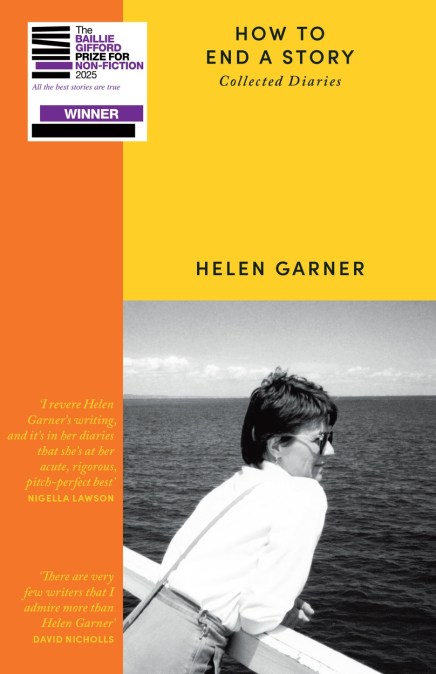
Helen Garner has kept a diary for most of her adult life. Now she is widely recognised as one of the greatest writers of our age. But, of all her books, it is her diaries that she likes best.
Collected for the first time into one volume, these inimitable diaries show Garner like never before: as a fledging author in bohemian Melbourne, publishing her lightning-rod debut novel while raising a young daughter in the 1970s; in the throes of an all-consuming love affair in the 1980s; and clinging to a disintegrating marriage in the 1990s.
How to End a Story reveals the inner life of a woman in love, a mother, a friend and a formidable writer at work. Told with devastating honesty, steel-sharp wit and an ecstatic attention to the details of everyday life, it offers all the satisfactions of a novel alongside the enthralling intimacy of something written in private and just for pleasure.
WITH AN INTRODUCTION BY LESLIE JAMISON
‘Acute, rigorous, pitch-perfect’
NIGELLA LAWSON
‘With sharp eyes and ears, Garner is a recording angel at life’s secular apocalypses’
JAMES WOOD, NEW YORKER
‘Dazzling, fearless greatness. I could not recommend this book more’
INDIA KNIGHT
‘An acclaimed celebrator of the poetic quotidian’
ANNE ENRIGHT
DAVID NICHOLLS
‘The greatest, richest journals by a writer since Virginia Woolf’s’
RACHEL COOKE, OBSERVER
‘Marvellous, all eight hundred pages of it’
COLM TÓIBÍN
‘The great Australian writer’s masterpiece’
THE TIMES
Helen Garner has kept a diary for most of her adult life. Now she is widely recognised as one of the greatest writers of our age. But, of all her books, it is her diaries that she likes best.
Collected for the first time into one volume, these inimitable diaries show Garner like never before: as a fledging author in bohemian Melbourne, publishing her lightning-rod debut novel while raising a young daughter in the 1970s; in the throes of an all-consuming love affair in the 1980s; and clinging to a disintegrating marriage in the 1990s.
How to End a Story reveals the inner life of a woman in love, a mother, a friend and a formidable writer at work. Told with devastating honesty, steel-sharp wit and an ecstatic attention to the details of everyday life, it offers all the satisfactions of a novel alongside the enthralling intimacy of something written in private and just for pleasure.
WITH AN INTRODUCTION BY LESLIE JAMISON
‘Acute, rigorous, pitch-perfect’
NIGELLA LAWSON
‘With sharp eyes and ears, Garner is a recording angel at life’s secular apocalypses’
JAMES WOOD, NEW YORKER
‘Dazzling, fearless greatness. I could not recommend this book more’
INDIA KNIGHT
‘An acclaimed celebrator of the poetic quotidian’
ANNE ENRIGHT
Reviews
The great Australian writer's masterpiece . . . As propulsive and thrilling as any domestic noir
An intimate set of reflections on writing, love, friendship, ethics, landscape and the torments of a failing marriage.
I revere Helen Garner's writing, and it's in her diaries that she's at her acute, rigorous, pitch-perfect best . . . If I could read Helen Garner all day every day, I'd regard it as a life well-lived
Mixing everyday observation and gossipy asides with profound self-examination, it is spare in style and utterly moreish.
Many writers' diaries have been published, but none carry the singular acuity, wit, and electric grace of Helen Garner's. A blend of pillow talk, bar gossip, and eavesdropping on therapy, they offer an intoxicating, astute account of the deep emotional movements of Garner's life over two decades
Glittering shards of experience . . . How to End a Story places the Australian pioneer of autofiction firmly among the great chroniclers of daily life . . . Garner's always able to let the light in
Garner, the Australian writer who pioneered the now popular genre of autofiction, shares her collected diaries, which stretch to more than eight hundred pages but essentially seek to answer a deceptively simple question she posed forty years ago: "Why do I write down this stuff?" This book - which won the 2025 Baillie Gifford Prize for Non-Fiction - provides an unflinching, complex and satisfying answer
Australia's greatest writer of nonfiction. How to End a Story concludes with one of the most candidly brutal accounts of the end of a creative marriage I've read
The celebrated Australian pioneer of autofiction shares her diaries . . . She explores her reading, writing and broader life in unflinching detail that gets to the heart of the complexity of being human
If you're going to spend a lot of time with a writer, they had better be good company. Helen Garner's doorstopper diaries, covering 1978-98, show that the Australian novelist and true crime writer fits the bill - she is funny, caustic, endlessly curious, a brilliant observer and eavesdropper, and recklessly candid . . . Her anatomy of marital disharmony is as gripping as any domestic thriller
I was utterly in [Garner's] hands . . . . This is one for the introverts - the wary and the peevish, the uncertain of their looks, taste, talent and class status. Garner has an ideal voice to express late-night pangs of precariousness and distress, some more comic than others. Her prose is clear, honest, and economical; take it or leave it, in the Australian manner
Masterpiece... At the core of her book is an intensely rich and complex sensibility at work, captured and cultivated as though she were a heroine in a classic novel.
An essential read. You'll revisit it forever . . . Dazzling, fearless greatness . . . I could not recommend this book more
The diaries are the apotheosis of Helen Garner's entire career, and the most exciting thing she has ever published . . . Polished and spare, like the very short stories of Diane Williams and Lydia Davis . . . Beautiful, riveting, formally electrifying
Absolutely jaw-dropping
I bought Helen Garner's journals, How to End a Story, thinking I'd dip in and then found myself reading compulsively for three days and wanting everyone else to read them so we could talk
The Australian writer Helen Garner seems to be finally getting her due . . . As in her court reporting and fiction, Garner has a way of telling it like it is in her diaries, and by publishing her innermost anxieties and furies while she's still alive, her frankness and stubborn refusal to dress up the truth makes for a record of a life that, despite its heft (more than eight hundred pages), feels urgent on every page
Helen Garner is a genius who never stops paying attention. Her chilling account of a failing marriage is as propulsive as any thriller
Not since reading Virginia Woolf's collected diaries has the life and times of one exceptional writer leapt so vividly from the page. Helen Garner 's renaissance should be sealed with this landmark publication - a writer both absolutely of Australia and of the entire world
Garner presents her secrets on the page - her affairs, her fears, her impulses and simple wishes (like the dream to eat a bag of cherries alone without sharing) - each entry separated by a dash, so that revelations about religion, relationships and writing emerge with the same significance as a plan to cook spinach for dinner
Garner has a way of telling it like it is in her diaries, and by publishing her innermost anxieties and furies while she's still alive, her frankness and stubborn refusal to dress up the truth makes for a record of a life that... feels urgent on every page.
Compulsive reading. It is a portrait of a rich writerly sensibility; it is a tale of two cities - Sydney and Melbourne; it is a story of motherhood; it is a searing account of the break-up of Garner's marriage to the novelist Murray Bail. What emerges most strongly and brilliantly is Garner as a born noticer, someone on whom nothing is lost
Endlessly fascinating . . . This is Garner's masterpiece
A masterpiece... Garner is a fascinating companion on the page
I come back again and again to Garner's diaries and always find something new to admire. Her wit and observations are brilliant and her thoughts on writing are a guide
Garner's diaries are a riveting monument to the creative process, as important as Virginia Woolf's, but with more sex and chaos. I could not stop reading
Every single page contains a passage of such distilled acuity and brilliance, it leaves you half drunk with exhilaration . . . These are the greatest, richest journals by a writer since Virginia Woolf's
Helen Garner's diaries How to End a Story rightly won the Baillie Gifford Prize for non-fiction. They show you all the different things writing can do, often on the same page
Garner is scrupulous, painstaking, and detailed, with sharp eyes and ears. She is everywhere at once, watching and listening, a recording angel at life's secular apocalypses
I LOVED Helen Garner's How To End A Story. It's so human and rooted in the simple activities of everyday life, yet there's an intellectual arc that just keeps you on your toes.
I love Helen Garner's diaries. I would read her grocery lists. I must have underlined something on every page
Long before I was a writer, I was a Helen Garner reader and fan. Her collected diaries are entrancing. It's rare we get to track the development of a great writer at such close quarters from her earliest days, revealed to us with such energy, freshness and intensity. But it's all here: the fearlessness, the unapologetic honesty, the ruthless self-examination and most important of all, the clarity of her gaze, the great delicacy and precision of her language. I will return to these diaries for the rest of my days
My overall book of the year? Helen Garner's collected diaries, How to End a Story. I read them compulsively, cover to cover like a psychological thriller - this testament to what it means for a woman to write, to make art, not just amid but from the quotidian, the domestic, the most intimate chambers of experience. An extraordinary work
Frank, gripping and revealing about family, marriage and the writing life
Marvellous, all eight hundred pages of it
Flinty brilliance
Helen Garner's work is a thrilling discovery. She's one of the most fascinating writers I have come across in recent years
Intimate, precise, sharp, vivid and funny, Helen Garner's diaries grant us not only vital insight into her creative process and concerns, but also to the inner workings of a great mind engaged in the business of daily life