
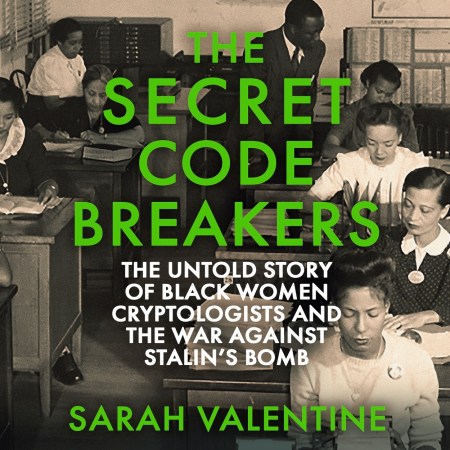
Hidden Figures meets The Imitation Game in this never-before-told true story of the segregated Black code breakers who helped America win the Cold War, set amid the civil rights movement.
This is the shocking true story of the Black American codebreaking unit whose top-secret work led directly to the end of the Cold War.
Facing the global threat of a rising Communist world power in the aftermath of World War II, the US employed hundreds of Black Americans to speed read Russian communications and gather essential information on the US’s most dangerous nuclear rival.
The result was the creation of a segregated civilian codebreaking unit known as the Traffic Processing Division – The Plantation. Despite wage discrimination, gruelling hours and harsh conditions, the Plantation’s 100 college-educated Black women made invaluable breakthroughs in United States’ Soviet intelligence, even as the backlash against civil rights eroded their democratic freedoms at home.
Sarah Valentine tells their remarkable story in full for the first time. Paying long overdue tribute to these little-known Black cryptologists’ critical contributions to national security during the civil rights era and the Cold War.
‘With relentless research and electric storytelling, Sarah Valentine restores the erased Black cryptologists who powered U.S. codebreaking from WWII through the Korean War. Urgent, revelatory, and impossible to ignore, Decoding the Devil unveils both the uncomfortable truths and the inspiring histories that form the foundation of our intelligence community’ – Nathalia Holt, New York Times bestselling author of Rise of the Rocket Girls and Wise Gals
‘A thought-provoking exploration of the lives and work of the largely forgotten, undervalued, and little-acknowledged Black (and mostly female) cryptologists who contributed to this nation’s intelligence success during World War II and the early Cold War. These contributions were made despite physically uncomfortable and segregated workspaces and assignments far below their education and capabilities. Sarah Valentine tells a fascinating tale, deftly weaving the cryptologic work into the social and political constraints of the times’ – Betsy Rohaly Smoot, author of Parker Hitt: The Father of American Military Cryptology
‘This book shows us the seams and man-making of a patriotic narrative usually sold to us as divine. Like Zora Neal Hurston loves us, Sarah Valentine loves us enough to tell the truth about our humanity inside of purposefully inhumane American institutions’ – Steven Dunn, author of Water & Power
This is the shocking true story of the Black American codebreaking unit whose top-secret work led directly to the end of the Cold War.
Facing the global threat of a rising Communist world power in the aftermath of World War II, the US employed hundreds of Black Americans to speed read Russian communications and gather essential information on the US’s most dangerous nuclear rival.
The result was the creation of a segregated civilian codebreaking unit known as the Traffic Processing Division – The Plantation. Despite wage discrimination, gruelling hours and harsh conditions, the Plantation’s 100 college-educated Black women made invaluable breakthroughs in United States’ Soviet intelligence, even as the backlash against civil rights eroded their democratic freedoms at home.
Sarah Valentine tells their remarkable story in full for the first time. Paying long overdue tribute to these little-known Black cryptologists’ critical contributions to national security during the civil rights era and the Cold War.
‘With relentless research and electric storytelling, Sarah Valentine restores the erased Black cryptologists who powered U.S. codebreaking from WWII through the Korean War. Urgent, revelatory, and impossible to ignore, Decoding the Devil unveils both the uncomfortable truths and the inspiring histories that form the foundation of our intelligence community’ – Nathalia Holt, New York Times bestselling author of Rise of the Rocket Girls and Wise Gals
‘A thought-provoking exploration of the lives and work of the largely forgotten, undervalued, and little-acknowledged Black (and mostly female) cryptologists who contributed to this nation’s intelligence success during World War II and the early Cold War. These contributions were made despite physically uncomfortable and segregated workspaces and assignments far below their education and capabilities. Sarah Valentine tells a fascinating tale, deftly weaving the cryptologic work into the social and political constraints of the times’ – Betsy Rohaly Smoot, author of Parker Hitt: The Father of American Military Cryptology
‘This book shows us the seams and man-making of a patriotic narrative usually sold to us as divine. Like Zora Neal Hurston loves us, Sarah Valentine loves us enough to tell the truth about our humanity inside of purposefully inhumane American institutions’ – Steven Dunn, author of Water & Power
Reviews
'A thought-provoking exploration of the lives and work of the largely forgotten, undervalued, and little-acknowledged Black (and mostly female) cryptologists who contributed to this nation's intelligence success during World War II and the early Cold War. These contributions were made despite physically uncomfortable and segregated workspaces and assignments far below their education and capabilities. Sarah Valentine tells a fascinating tale, deftly weaving the cryptologic work into the social and political constraints of the times'
'In intelligence, as in all fields, a nation benefits when it taps the gifts and talents of all citizens--and suffers when it does not. It took America a long time to learn this and we are at constant risk of forgetting it. Sarah Valentine through her research has recovered this message anew, showcasing the Black women code breakers who, subjected to appalling conditions and relegated to the bleakest rooms, worked to safeguard our safety and stability during perilous times'
'An illuminating account of the dauntless and largely unacknowledged cadre of Black women who had to work within the early NSA and its predecessors for the "Triple V"-victory over fascism, victory over racism, and victory over sexism. Sarah Valentine makes a convincing case that the Agency's ingrained racism and sexism was not just a moral failing, but an operational defect with real security consequences in the Cold War era'
'vividly demonstrates that, behind some of the greatest technological security innovations, there are masses of people whose rights were violated and whose contributions remain unrecognized'
'With relentless research and electric storytelling, Sarah Valentine restores the erased Black cryptologists who powered U.S. codebreaking from WWII through the Korean War. Urgent, revelatory, and impossible to ignore, Decoding the Devil unveils both the uncomfortable truths and the inspiring histories that form the foundation of our intelligence community'
'This book shows us the seams and man-making of a patriotic narrative usually sold to us as divine. Like Zora Neal Hurston loves us, Sarah Valentine loves us enough to tell the truth about our humanity inside of purposefully inhumane American institutions'