
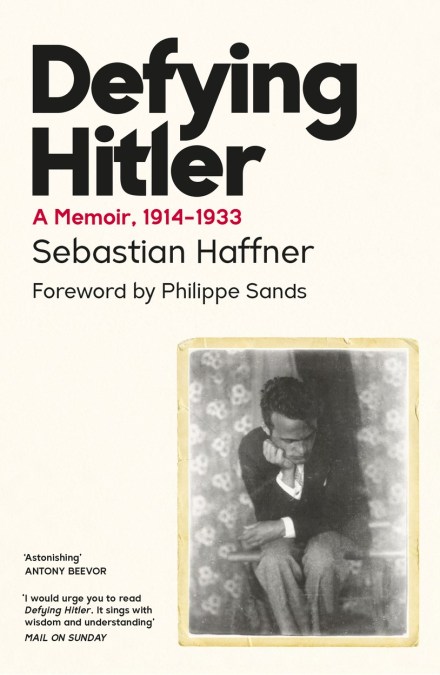
‘If you have never read a book about Nazi Germany before, or if you have already read a thousand, I would urge you to read Defying Hitler. It sings with wisdom and understanding’ CRAIG BROWN, MAIL ON SUNDAY
AN ORDINARY GERMAN’S MEMOIR OF HITLER’S RISE TO POWER
Born in Berlin in 1907, Sebastian Haffner came of age against the backdrop of a rapidly-changing Germany: an economy ravaged by the First World War, the radicalisation of political parties through the Weimar years, the fateful rise of Hitler’s National Socialists. He watched as his peers were entranced by Nazi propaganda, even himself briefly feeling the pull of an ideology that promised purpose and pride in the face of nihilism and defeat.
Yet Haffner defied Nazism’s promises and, as a political émigré, went on to author some of the century’s most important studies of Hitler and the Nazis. This memoir – written in 1939 after his emigration to England, but only discovered after his death six decades later – is an astonishingly insightful portrait of that generation of Germans born in the first decade of the twentieth century who, in such large part, came to be seduced by Hitler and Nazism. Critically acclaimed around the world by scholars and readers alike, it is an invaluable record of a society on the precipice of catastrophe.
‘An astonishingly effective and well-written explanation of how the Nazis managed so easily to exploit Germany’s psychological weaknesses’ ANTONY BEEVOR
AN ORDINARY GERMAN’S MEMOIR OF HITLER’S RISE TO POWER
Born in Berlin in 1907, Sebastian Haffner came of age against the backdrop of a rapidly-changing Germany: an economy ravaged by the First World War, the radicalisation of political parties through the Weimar years, the fateful rise of Hitler’s National Socialists. He watched as his peers were entranced by Nazi propaganda, even himself briefly feeling the pull of an ideology that promised purpose and pride in the face of nihilism and defeat.
Yet Haffner defied Nazism’s promises and, as a political émigré, went on to author some of the century’s most important studies of Hitler and the Nazis. This memoir – written in 1939 after his emigration to England, but only discovered after his death six decades later – is an astonishingly insightful portrait of that generation of Germans born in the first decade of the twentieth century who, in such large part, came to be seduced by Hitler and Nazism. Critically acclaimed around the world by scholars and readers alike, it is an invaluable record of a society on the precipice of catastrophe.
‘An astonishingly effective and well-written explanation of how the Nazis managed so easily to exploit Germany’s psychological weaknesses’ ANTONY BEEVOR
Reviews
If you have never read a book about Nazi Germany before, or if you have already read a thousand, I would urge you to read DEFYING HITLER. It sings with wisdom and understanding
As a memoir of life in Germany during the Nazi rise to power, it is unsurpassable
An astonishingly effective and well-written explanation of how the Nazis managed so easily to exploit Germany's psychological weaknesses
Nothing less than a clear-eyed autobiographical analysis of the German character as it appeared to the writer, and who experienced it, in his own heart and mind . . . Raw, revelatory stuff . . . Haffner distils the essence of the Weimar Republic: its snapshot scenes are little nuggets of pure sensation informed by sensibility
Raw, passionate . . . Reads as compellingly as a top-class thriller. The outstanding impression you get as Haffner takes you from day to day through early 1933 is how easy it was for Hitler, beginning in such small ways, to turn a civilised, intelligent people into a helpless, penned-in flock of sheep
Each of us sometimes asks what we would have done if we had been young and German in 1933. There could scarcely be a better way to explore this question than to read Haffner's book . . . He is vivid, concise, lucid, penetrating, humane, brave, playful and profound: a representative of the German civilisation which thuggish German nationalists tried to destroy
Brilliant, moving and terrifying
An unforgettable memoir of life in Germany during the rise of the Nazis, a mesmerising study of the way a generation surrendered to Hitler
Haffner's outstanding gifts of observation and imagination enabled him to reconstruct, vividly and convincingly, the state of mind of the German people during the tumultuous decades before 1933
A riveting story
As gripping as any thriller I've ever read